The conversation around AI has moved quickly, from theoretical potential to a board-level priority.
For organisations handling sensitive data or critical services, adopting AI is becoming central to staying competitive in an increasingly automated landscape.
The path isn’t always smooth. When the stakes involve financial stability, sensitive data or essential infrastructure, the momentum behind AI often meets a wall built from risk and oversight.
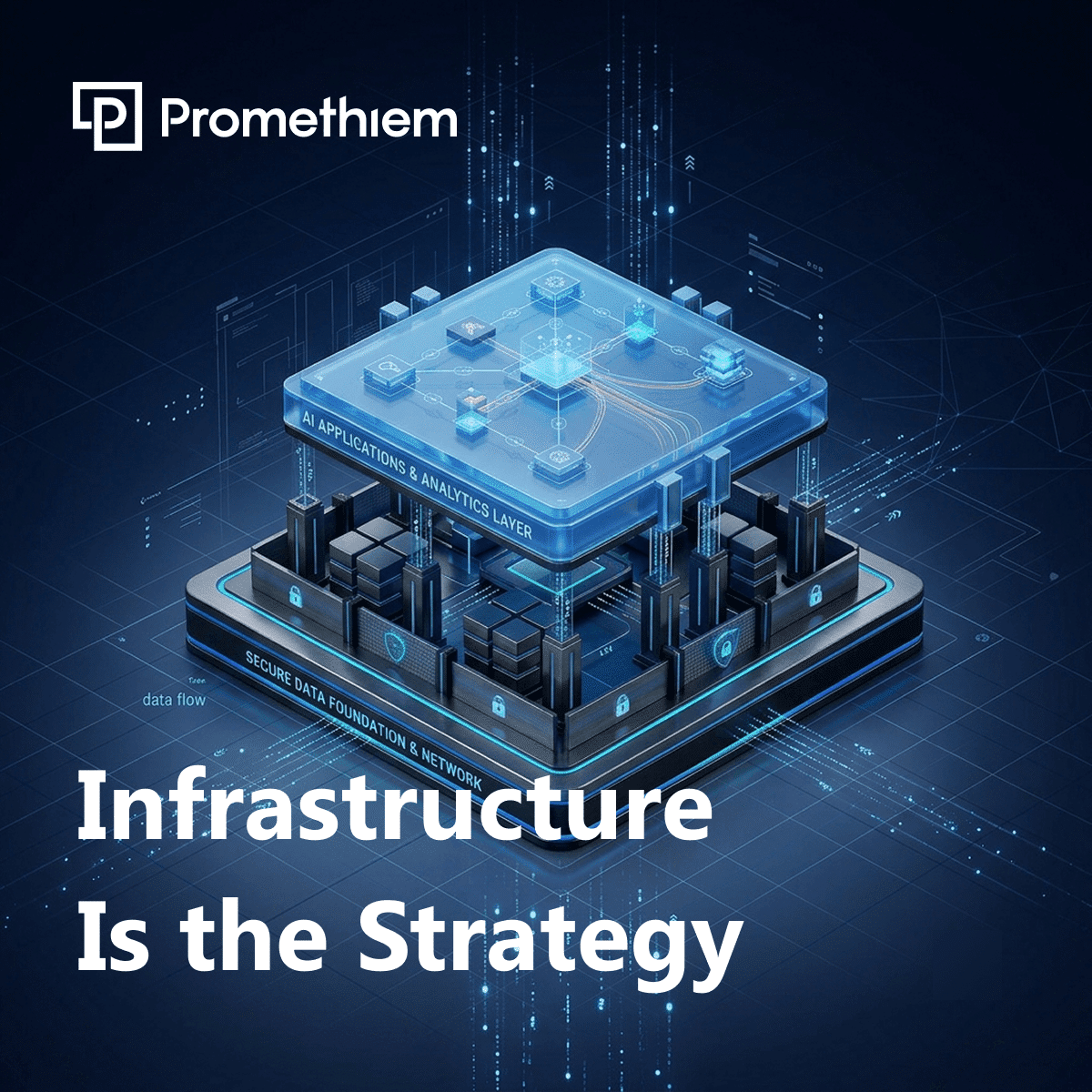
Many leaders are finding that the constraint isn’t the model. It’s the architecture beneath it. AI adoption depends on having the right infrastructure in place first.
The illusion of plug-and-play AI
There’s a common assumption that AI is a layer of software that can be draped over existing systems. In reality, it’s a resource-intensive, data-hungry evolution of computing that needs a specific kind of environment to run safely. Unmanaged deployments, sometimes called shadow AI, carry real risk.
Run advanced models or predictive analytics on legacy infrastructure and a visibility gap tends to open up. Without a purpose-built environment, it becomes hard to track how data is processed, from where it’s stored to who can reach the model’s outputs.
Integrating AI before establishing secure infrastructure often leads to operational friction once the technology reaches scale. The software may perform well in testing. The framework beneath it struggles with the security and technical demands of a live environment.
So the focus needs to shift. Less on the capabilities of the AI itself, more on the technical reliability of the environment it runs in.
Creating a secure environment
The first pillar of AI readiness is a secure environment.
Data is the most valuable Digital Asset in play, and the most sensitive. AI needs large datasets for training and inference, often including personal information or proprietary intellectual property.
A secure architecture creates a walled garden for AI activity. Beyond standard firewalls, it centres on purpose-configured cloud environments that host workloads safely, often called isolated landing zones.
This keeps data within a protected perimeter, away from unauthorised internal systems.
Data sovereignty and compartmentalisation
Where data sits can matter as much as how it’s used.
Secure enclaves and hardware-level encryption mean that even when a model is refined by a third-party partner, the underlying raw data stays encrypted and out of reach of the model provider.
Strong architectural oversight lets organisations move from a restricted posture to a more proactive one. A secure sandbox gives developers room to experiment within a controlled environment. Security stops being a brake and starts to enable the work.
Embedded controls: governance at speed
In traditional software, governance is often retrospective: audits and periodic reviews. AI moves too fast for that.
A model can make thousands of generations in seconds. A governance framework that relies on someone checking a log at the end of the week is already behind.
Embedded controls answer this. Compliance and oversight are baked into the architecture, so the system itself enforces the rules of engagement.
Treating governance as code lets organisations automate their guardrails. If a model tries to reach a restricted database or produce an output beyond a defined threshold, the infrastructure can intercept and block the action.
Controls like these create a continuous audit trail. The black-box nature of AI is a common concern, and a secure architecture answers it with explainability by design. It logs not just the output, but the lineage of the data and the model parameters at the moment of execution.
That level of transparency lets an organisation show it remains in control, even when the technology is complex.
Resilient architecture: continuity in an automated world
When AI becomes core to a workflow, such as detecting fraud or balancing energy loads, it turns into a critical-path component. If the model hits unexpected downtime, operations can follow.
That introduces a new kind of risk: the need for genuine operational continuity.
Resilient architecture is built to withstand the specific pressures of AI. These workloads run in bursts, demanding large amounts of compute at unpredictable moments. A standard corporate network can struggle under a large inference task, and other essential services feel it.
A resilient foundation uses cloud-native principles to keep AI workloads manageable and efficient.
- Isolation of workloads keeps AI processes separate from core transactional systems, so high-demand tasks don’t disrupt day-to-day operations.
- Auto-scaling lets the infrastructure absorb sudden peaks in demand without degrading performance elsewhere.
- Graceful degradation means that if a primary model goes offline or returns anomalous results, the architecture can fail over to a simpler, deterministic process.
Together these keep performance and service continuity intact. The point is to protect the wider business, so a customer service portal keeps working even if an AI chatbot needs attention.
Managed service capability: keeping a human in the loop
Even with strong hardware and software, AI can’t be left entirely to its own devices. Monitoring for model drift, applying security patches and keeping data pipelines clean is often beyond internal teams that are already stretched.
This is where managed service capability earns its place. It adds a layer of expert oversight that keeps the AI infrastructure maintained to a high standard.
Models aren’t static. They shift over time as real-world data diverges from their original training data. A drifting model can produce inaccurate outputs, from skewed decisions to poor recommendations.
Ongoing oversight catches these issues early. A dedicated team, or an automated management layer, checks the model’s performance against trusted reference datasets and holds quality steady.
This turns staying compliant from a stressful periodic event into a quiet, reliable background process.
The cost of architectural debt
Skipping the architectural groundwork in favour of quick, low-cost implementations creates architectural debt.
Like technical debt, it’s a hidden cost that compounds. A small pilot might run fine on a standard server. As it scales to a department, then across the organisation, the missing foundations start to show as operational friction.
Left unchecked, architectural debt reaches a dead end. The risk of the next project outweighs the benefit, and progress stalls.
From proof of concept to proof of control
For leadership, the aim is the most trusted AI system possible.
A secure environment, embedded controls and a resilient framework change the internal story around AI. It moves from risky experiment to a standard part of the toolkit.
That structural integrity frees leadership to focus on the meaningful outcomes: better customer experiences, greater efficiency, quicker response to the market, with confidence that the ground-level mechanics are handled by a system designed for the task.
Foundations first
Sustainable AI adoption isn’t a race to deploy models as fast as possible. It’s a long-term commitment, held by the organisations with the stamina to build the foundations.
Where the margin for error is slim, the infrastructure is the strategy. Prioritise secure architecture and progress can move at a steadier, faster pace, with less need to pause and patch vulnerabilities or explain anomalies after the fact.
The next generation of AI tools then integrates more easily, because the underlying framework, the organisational chassis, is already engineered for the demands.
The long-term outcomes will belong to the organisations with the best environments for execution. The opportunity now is to move beyond discussing AI’s potential and start building the secure foundations it needs to take that ambition to genuinely new places.
